
DeepSeas TIDE has identified six domains, registered on 8 October 2026 between 13:36 and 13:56 UTC, that it assesses with high confidence belong to the same infrastructure operation behind the CLOUDHAZE malware family. CLOUDHAZE is delivered through malvertising on invoice-themed websites and has been reported in use against a US healthcare organization. Other domains associated with older potential CLOUDHAZE operations were also identified, and are included in this report.
The six domains are the fifth registration wave in a cluster of at least 23 domains that DeepSeas TIDE has traced back to February 2026. All 23 share the same provisioning fingerprint: registered through NameCheap with WHOIS privacy, DNS and hosting on Cloudflare, no subdomains, and no mail records except on one domain. New waves have arrived every 78 to 85 days. Two domains from earlier waves, familypenguins[.]com and apexesmasters[.]com, have been publicly reported as CLOUDHAZE C2.
None of the six new domains is live. DNS and TLS are configured, but no content has been deployed and DeepSeas TIDE has found no malware samples referencing them. They are published now so defenders can block them before first use.
The new wave keeps the cluster’s two-word naming structure but replaces the earlier animal and plant themes with technology terms. The change followed public reporting in September 2026 that named earlier CLOUDHAZE C2 domains. It is a reason to detect this operation by its provisioning fingerprint rather than by the look of its domain names.
What is not known: the role the new domains will play. A third-party threat-intelligence platform labels them as Keitaro traffic distribution system (TDS) infrastructure rather than malware C2. Both roles fit the malvertising delivery chain reported for CLOUDHAZE; this report keeps them apart below.
Six Suspected CLOUDHAZE Next-Wave Domains Identified
- Registered: 8 October 2026, 13:36:34–13:55:46 UTC
- Registrar / hosting: NameCheap / Cloudflare
- Content deployed: None as of October 2026
- Samples observed: None as of October 2026
Blocking newly registered, unused domains carries little operational risk. Doing so now closes the window in which they would otherwise sit unrated and unblocklisted once the operators begin using them. Dormancy is the expected state ahead of operational use and is not a sign that the wave is inactive.
Background & Monitoring Timeline
| When | What happened |
|---|---|
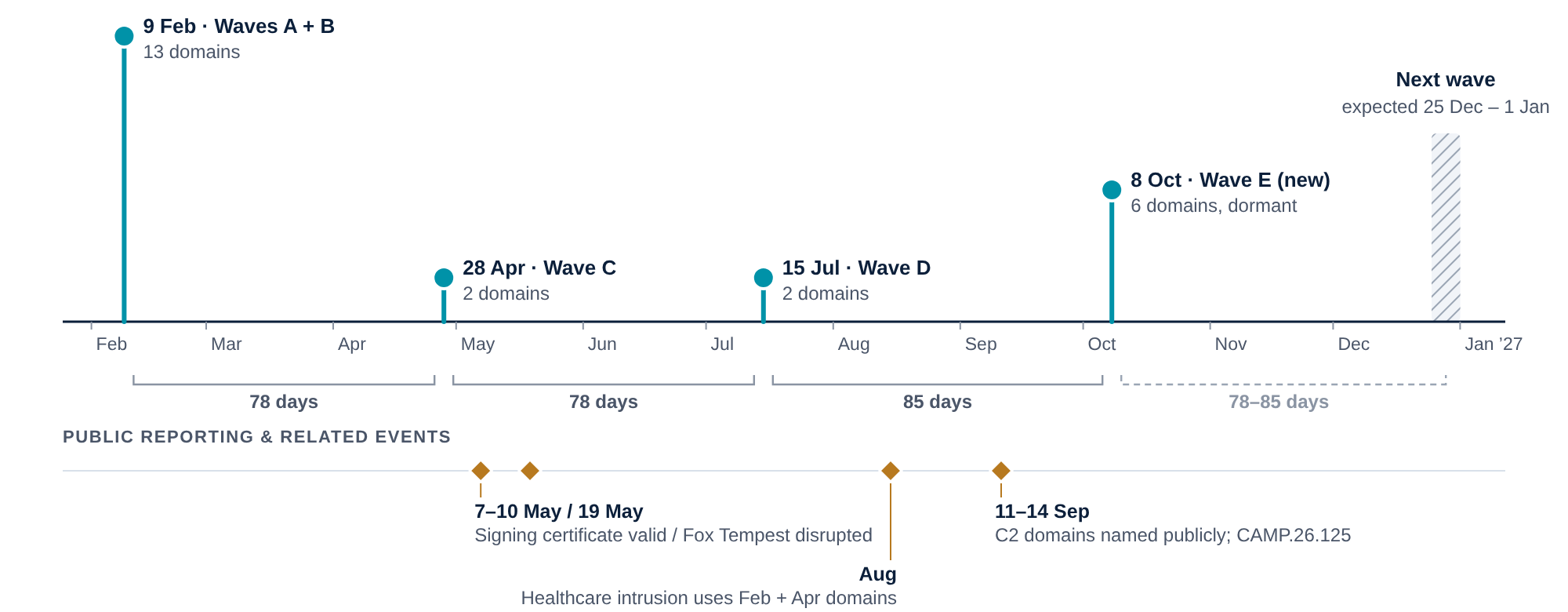
| 9 February 2026, 15:47–18:07 UTC | Waves A and B: 13 two-word domains, mostly animal- and plant-themed, registered in two bursts about 2 hours 19 minutes apart, including familypenguins[.]com and foxbamboo[.]com. |
| 28 April 2026, 19:04 UTC | Wave C: apexesmasters[.]com and westbeavers[.]com registered 13 seconds apart (78 days after wave B). |
| 15 July 2026, 16:34 UTC | Wave D: hedgehogsbunny[.]com and wombatswilson[.]com registered 23 seconds apart (78 days after wave C). |
| August 2026 | Per public reporting, Google Threat Intelligence (GTI) operation record OP.26.1312 documents threat cluster UNC7072 using CLOUDHAZE against a US healthcare-subsector organization, with C2 domains including apexesmasters[.]com and familypenguins[.]com. |
| 11 September 2026 | CloudWave’s weekly threat brief summarizes OP.26.1312, publicly naming the two C2 domains. |
| 14 September 2026 | GTI creates campaign record CAMP.26.125: malvertising on invoice-related websites leading to CLOUDHAZE, tied to the same actor record as OP.26.1312 (summarized in CloudWave’s 18 September brief). |
| 8 October 2026, 13:36–13:56 UTC | Wave E: six technology-themed domains registered in two bursts 18 minutes apart (85 days after wave D). |
| 12 October 2026 | DeepSeas TIDE’s fingerprint hunt surfaces wave E. All six domains are dormant, with no content deployed and no samples in public repositories. DeepSeas TIDE publishes this report. |
Domain Indicator Summary — CLOUDHAZE-Linked Registration Cluster
All 23 domains share the provisioning fingerprint described in this report. Highlighted rows are wave E, new and not yet observed in use.
| Domain | Wave | Registered (UTC) | Note |
|---|---|---|---|
| bezelboard[.]com | E | 2026-10-08 13:36:34 | NEW — dormant |
| wooferwood[.]com | E | 2026-10-08 13:36:45 | NEW — dormant |
| rollrink[.]com | E | 2026-10-08 13:36:54 | NEW — dormant |
| modemmesh[.]com | E | 2026-10-08 13:37:13 | NEW — dormant |
| immersiondock[.]com | E | 2026-10-08 13:55:37 | NEW — dormant; second burst |
| castandscreen[.]com | E | 2026-10-08 13:55:46 | NEW — dormant; second burst |
| hedgehogsbunny[.]com | D | 2026-07-15 16:34:46 | |
| wombatswilson[.]com | D | 2026-07-15 16:35:09 | |
| apexesmasters[.]com | C | 2026-04-28 19:04:17 | Publicly reported CLOUDHAZE C2 (Aug 2026 operation) |
| westbeavers[.]com | C | 2026-04-28 19:04:30 | Carries unexpected trust signals; under review |
| foxsilk[.]com | B | 2026-02-09 18:07:13 | |
| familypenguins[.]com | B | 2026-02-09 18:07:14 | Publicly reported CLOUDHAZE C2; serves a malware-warning interstitial |
| flowerotter[.]com | B | 2026-02-09 18:07:14 | |
| healskills[.]com | B | 2026-02-09 18:07:19 | |
| hidingpandas[.]com | B | 2026-02-09 18:07:19 | |
| coverleaders[.]com | B | 2026-02-09 18:07:34 | |
| commonhedgehogs[.]com | A | 2026-02-09 15:47:56 | |
| foxbamboo[.]com | A | 2026-02-09 15:47:56 | Only domain with a mail record; High risk; likely control node |
| chipmunklilies[.]com | A | 2026-02-09 15:47:56 | |
| hugechipmunks[.]com | A | 2026-02-09 15:48:01 | |
| brothersrose[.]com | A | 2026-02-09 15:48:07 | |
| hedgehogclock[.]com | A | 2026-02-09 15:48:14 | |
| motherotters[.]com | A | 2026-02-09 15:48:20 |
Findings & Context
One operator, one provisioning script, five waves
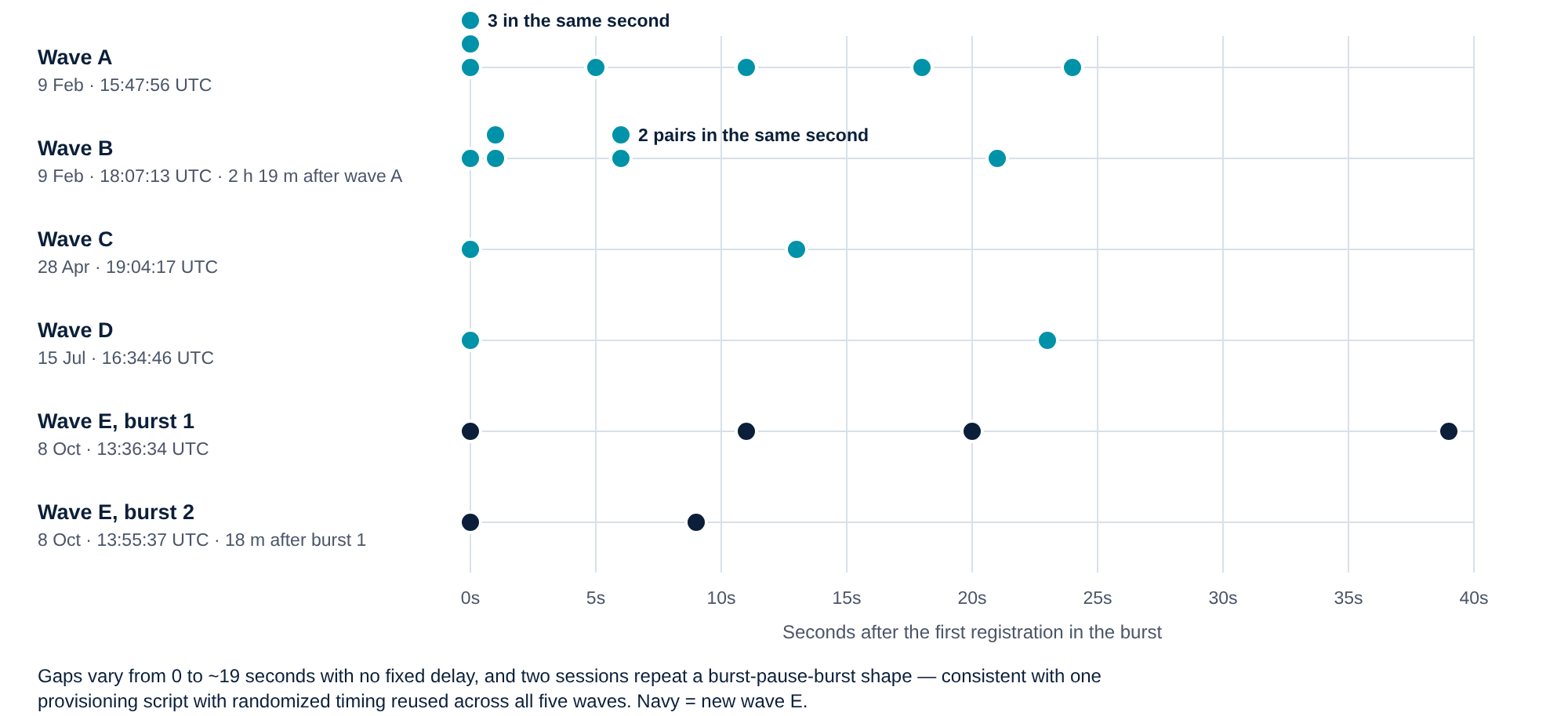
Every domain in the cluster was registered through NameCheap with WHOIS privacy, hosted on Cloudflare, and left without subdomains or mail records. The exact registration timestamps show the same automated tooling at work in every wave.
- Within each wave, registrations are seconds apart with no fixed delay: gaps range from zero to about 19 seconds, and several domains were registered in the same second (three at once in wave A). This points to an automated script with randomized timing, not an actor registering domains by hand.
- The two multi-domain days share a session shape: a first burst, a pause, then a smaller second burst. On 9 February the pause was about 2 hours 19 minutes; on 8 October it was about 18 minutes.
- Waves have arrived 78, 78 and 85 days apart. On that cadence, the next wave would be expected between roughly 25 December 2026 and 1 January 2027.
- Older domains remain in use after new waves arrive. The August 2026 operation used familypenguins[.]com (February) and apexesmasters[.]com (April) months after they were registered, so defenders should keep earlier-wave domains blocked.
- Actors have been observed updating CLOUDHAZE installations with new C2 domains, on at least one occasion.
The Link to CLOUDHAZE
The cluster is tied to CLOUDHAZE through two of its own members. Public reporting attributed to GTI names the domains familypenguins[.]com and apexesmasters[.]com as C2 infrastructure used by the CLOUDHAZE operators against a US healthcare organization in August 2026. Both these C2 domains share the fingerprint of the rest of the cluster.
- familypenguins[.]com serves a malware-warning interstitial page, unlike the generic bot-challenge page served by the other cluster domains. This is independent third-party corroboration that the domain has been flagged for malicious use.
- foxbamboo[.]com, from the first wave, is the only domain with a mail-exchange record. It carries a High risk rating, a history of short-lived certificates and a past blocklist appearance, and is the likeliest control node for the operation.
- Each CLOUDHAZE sample DeepSeas TIDE has examined contains a single C2 domain; operators do not mix domains within a sample, though based on analysis of publicly-available samples the operators have the capability to, and occasionally do, update the installed malware with a new C2.
A Human-Readable Beacon Format
CLOUDHAZE beacons to its C2 using a fixed first path segment followed by a light- or optics-themed word, a pattern distinctive enough to hunt for in proxy logs regardless of the domain in use.
- Observed beacon URLs: hxxps://familypenguins[.]com/filament/resonance, /filament/photon, /filament/prism and /filament/radiance.
- DeepSeas TIDE has not yet determined whether the path words are generated per victim, per installation, or per data type. One working hypothesis is that each path is a separate drop point for a category of stolen data (credentials, browser session tokens, cryptocurrency wallets); this is unconfirmed.
Lures and Code Signing
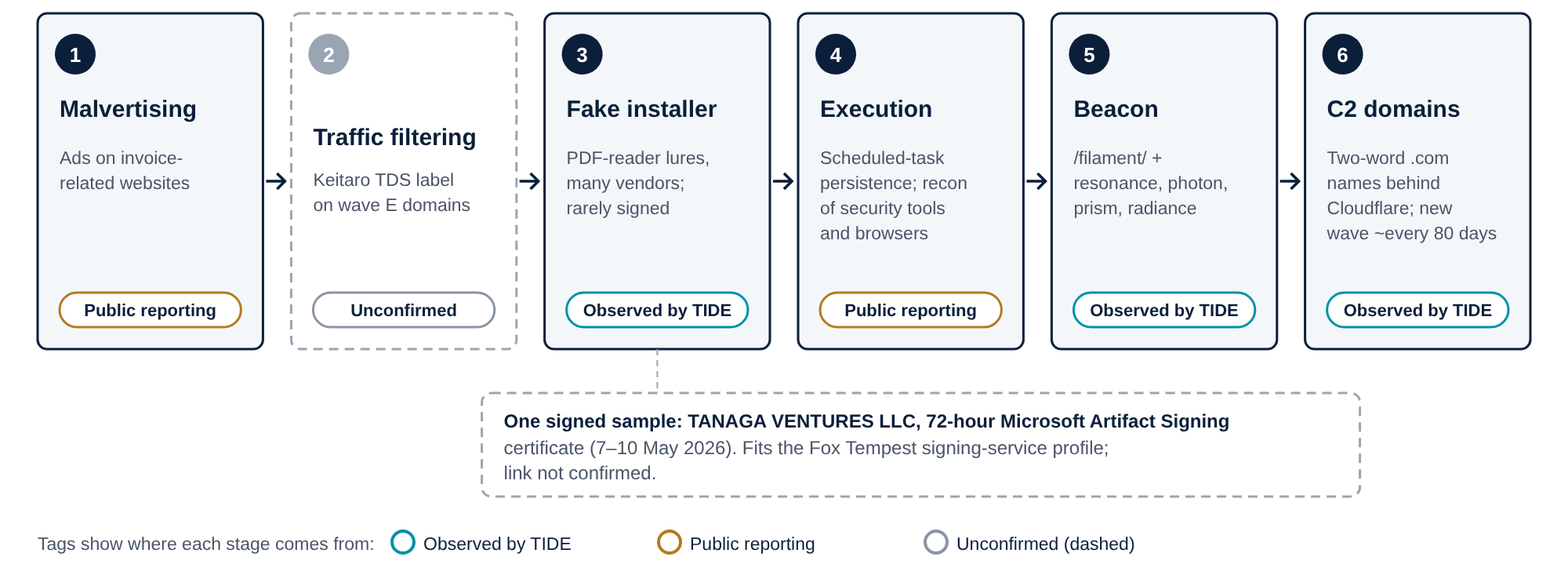
CLOUDHAZE is distributed mostly as fake PDF-reader installers impersonating several different vendors. Code signing is rare, but one signed sample carries a short-lived certificate from Microsoft’s cloud code-signing service, the same service a malware-signing operation disrupted by Microsoft in May 2026 abused to sign Lumma Stealer and other malware.
- The certificate was issued to TANAGA VENTURES LLC by Microsoft ID Verified CS AOC CA 03 and was valid for 72 hours, from 7 to 10 May 2026. Microsoft’s Artifact Signing service (formerly Trusted Signing) issues identity-verified certificates of exactly this kind and lifetime. Full details are in the table below.
- Signatures made while such a certificate was valid can continue to verify after it expires, so the expiry shown by analysis tools does not make the signed sample less trustworthy to Windows. Only revocation by the issuer does.
- On 19 May 2026 Microsoft announced the disruption of Fox Tempest, a malware-signing-as-a-service operation active since May 2025. It created more than 1,000 short-lived Artifact Signing certificates, likely using stolen US and Canadian identities, and signed malware including Lumma Stealer, Vidar and Oyster. The TANAGA VENTURES certificate fits that profile and time frame, but DeepSeas TIDE cannot confirm it was issued through Fox Tempest.
- DeepSeas TIDE has also seen a sample signed with a certificate issued to a Chinese company. Signing identities like these are commonly bought, stolen or fraudulently obtained, so they say little about where the operators are.
- Some security-vendor detections label CLOUDHAZE samples as Lumma Stealer. DeepSeas TIDE has not verified any code relationship. A shared signing service is one possible reason for the overlap, since detections sometimes key on signing certificates; until a code link is confirmed, DeepSeas TIDE treats the overlap as a detection-naming quirk.
- Per public reporting on GTI’s CAMP.26.125, CLOUDHAZE persists through scheduled tasks and enumerates running processes, security-software status and browser profile data, behavior consistent with an infostealer.
Code-Signing Certificate — Signed CLOUDHAZE Sample
| Field | Value |
|---|---|
| Subject | TANAGA VENTURES LLC |
| Issuer | Microsoft ID Verified CS AOC CA 03 |
| Valid from / to | 7 May 2026 11:51 – 10 May 2026 11:51 |
| Thumbprint (SHA1) | 0E09B2A441411EB067B41082D2FAD81EA57C93C3 |
| Serial number | 33 00 00 C8 56 CB BF D9 3A 11 3F D2 FC 00 00 00 00 C8 56 |
| Algorithm | sha384RSA |
| Enhanced key usage | Code Signing; 1.3.6.1.4.1.311.97.1.0; 1.3.6.1.4.1.311.97.281185357.576631280.490345664.157770800 |
Wave E — a new naming theme on an unchanged build
The six 8 October domains match the cluster’s provisioning fingerprint and timing in every respect except the theme of their names: technology and lifestyle terms (bezel, woofer, modem, dock, screen, rink) in place of animals and plants (hedgehog, chipmunk, fox, panda, penguin, otter, beaver, wombat).
- The fingerprint narrowed the millions of domains registered in the window to fewer than a thousand candidates before the naming and timing criteria were applied.
- The theme change came about three weeks after public reporting named familypenguins[.]com and apexesmasters[.]com. It may be a deliberate attempt to defeat naming-based detection; it may also be routine lure rotation.
- The domains resolve to at least 12 shared Cloudflare edge addresses with no dedicated or attributable behavior, so they can only be blocked by name.
A possible Keitaro TDS link in the delivery chain
A third-party threat-intelligence platform labels the wave E domains as Keitaro infrastructure. Keitaro is a commercial ad tracker and traffic distribution system (TDS) widely abused in malvertising, which fits the invoice-site malvertising route reported for CLOUDHAZE.
- A TDS filters visitors by location, device and other attributes and sends only selected targets on to a payload, showing decoy content to everyone else. Infoblox and Confiant reported in March 2026 that nearly 2,000 Keitaro domains were in malvertising use and that cracked Keitaro licenses circulate on criminal forums.
- If the label is accurate, some or all of the wave E domains may handle the traffic-routing stage that leads victims to CLOUDHAZE, not post-infection C2. Either role makes them worth blocking.
- Because the domains sit behind Cloudflare and serve no content yet, DeepSeas TIDE cannot confirm the Keitaro label.
DeepSeas TIDE Assessment — Wave E belongs to the CLOUDHAZE operation
DeepSeas TIDE assesses with high confidence that the six 8 October 2026 domains were provisioned by the same operator, using the same tooling, as the cluster that includes the publicly reported CLOUDHAZE C2 domains familypenguins[.]com and apexesmasters[.]com. It assesses with medium confidence that they will be used in CLOUDHAZE operations, as C2 or as delivery infrastructure.
Basis
- Identical registrar, hosting, WHOIS-privacy and DNS-record profile across all 23 domains and five waves.
- Exact-timestamp analysis shows the same randomized-interval, burst-pause-burst registration pattern on 9 February and 8 October.
- Wave E arrived 85 days after wave D, in line with the 78–85-day cadence of earlier waves.
- Two earlier cluster members are publicly reported as CLOUDHAZE C2 in an August 2026 operation.
What would change this
The use of the domains is the less certain part. Confidence would rise if a CLOUDHAZE sample referencing a wave E domain appears, a mail record is added, or the domains begin serving the /filament/ beacon path. It would fall if wave E is tied to an unrelated operator sharing the same registrar and hosting, or stays unused well past the next expected wave.
DeepSeas TIDE Assessment — Naming change and delivery chain
DeepSeas TIDE assesses with low confidence that the operators changed their naming theme in response to September 2026 public reporting, and that the Keitaro TDS label on the wave E domains reflects the malvertising stage of the CLOUDHAZE delivery chain. Keitaro TDS is ostensibly legitimate, though cracked and stolen licenses are often abused by threat actors, and should not be taken as a confirmed indicator of malicious activity.
Basis
- The theme change follows public naming of two cluster domains by about three to four weeks, but the operators may rotate lure themes for other reasons.
- Public reporting describes CLOUDHAZE delivery through malvertising on invoice-related websites, the use case a TDS supports.
- A single third-party platform’s label of the new domains as Keitaro infrastructure, not yet independently verified.
What would change this
Confidence would rise if the domains are seen redirecting ad traffic to CLOUDHAZE payloads; it would fall if the Keitaro label proves to belong to an unrelated operator. As yet, the newly registered CLOUDHAZE C2 domains have not been observed communicating with malware payloads.
Investigated, Not Yet Confirmed
- Meaning of the naming themes. Whether each animal or plant name marks a separate sub-campaign (by industry or country) was considered; no evidence for it has been found.
- westbeavers[.]com. Registered in the same 13-second window as apexesmasters[.]com but carries trust signals normally associated with long-established, high-traffic domains. Flagged for manual review; the trust signals should not be taken as evidence the domain is benign.
- Lumma Stealer relationship. Detection-name overlap only; no code or infrastructure link verified.
- Live use of wave E. No content, samples or beacons observed as of publication.
Recommended Actions
Now
- Block all 23 cluster domains (and their subdomains) at DNS-filtering, web proxy and email gateway layers, including the six wave E domains and the earlier waves, which have stayed in use months after registration.
- Hunt proxy and DNS logs for the beacon pattern: HTTPS requests whose path begins
/filament/followed by resonance, photon, prism or radiance, regardless of domain. - Search endpoint telemetry for the reported behavior chain: scheduled-task creation followed by enumeration of security software and browser profiles.
This week
- Brief accounts-payable, procurement and revenue-cycle staff, the people most likely to visit invoice-themed sites, on malvertised downloads and fake PDF-reader installers.
- Review web-filter coverage of advertising networks and restrict software installation to approved PDF readers from managed sources.
- Hunt for binaries signed by TANAGA VENTURES LLC (thumbprint
0E09B2A441411EB067B41082D2FAD81EA57C93C3), and review any recently installed software signed through Microsoft’s identity-verified code-signing service by a publisher you do not recognize. A valid signature is not evidence that a file is safe. - Prepare an infostealer response playbook: on any suspected infection, revoke browser session tokens and reset credentials stored in the browser, not only the user’s primary password.
Ongoing
- Detect by fingerprint, not by name. Where your threat-intelligence tooling allows, flag new domains that combine NameCheap registration, WHOIS privacy, Cloudflare hosting, no subdomains or mail records, and a two-word .com name.
- Watch for the next wave between roughly 25 December 2026 and 1 January 2027.
Sources
- DeepSeas TIDE analysis of domain-registration, DNS and hosting data and of public malware repositories, as of 12 October 2026
- CloudWave, Threat Brief: September 11, 2026 (summarizing GTI OP.26.1312)
- CloudWave, Threat Brief: September 18, 2026 (summarizing GTI CAMP.26.125)
- The Record, Microsoft disrupts Fox Tempest malware-signing service (19 May 2026)
DeepSeas TIDE will continue monitoring the wave E domains and the cluster’s registration fingerprint, and will update this report when content, samples, mail records or a new wave are observed.
Questions or suspected activity?
Questions about this report, or concerned this activity touches your environment? Contact the DeepSeas team at [contact@deepseas.com](mailto:contact@deepseas.com).